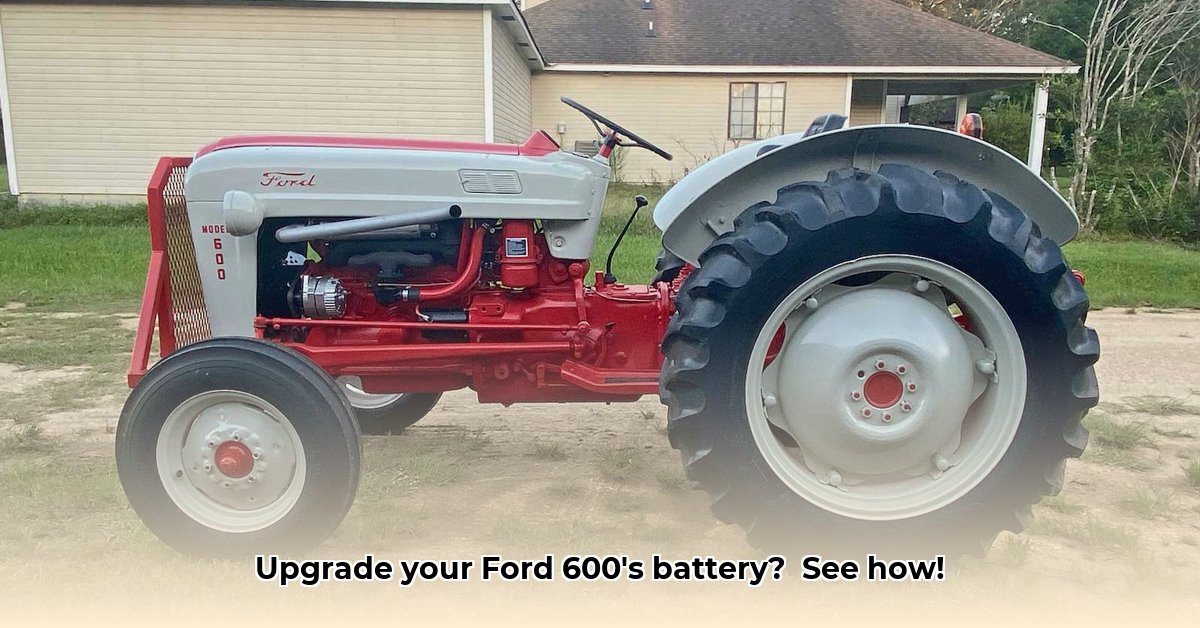
Thinking about upgrading your Ford 600 tractor from a 6-volt to a 12-volt system? This comprehensive guide provides a step-by-step process for a successful conversion, ensuring optimal performance and reliability for years to come. Whether you're a seasoned mechanic or a weekend warrior, we'll equip you with the knowledge and confidence to tackle this project. For more detailed Ford 600 information, check out this helpful resource: Ford 600 information.
Sizing Up Your Battery Needs: Group Sizes and Beyond
Before purchasing a replacement battery, measure your existing 6-volt battery. It's likely a Group 1 size (approximately 8-7/8" L x 6-7/8" W x 8" H). This provides a baseline for selecting a 12-volt replacement. Popular options include Group 25 or 26 batteries, offering a slightly smaller footprint but usually fitting without issue. Group 35 batteries are similar in size to Group 25 but differ in terminal placement. Accurate measurements are essential for a proper fit. What size battery do you need for your Ford 600? Precise measurements will determine the best fit.
Beyond CCA: Choosing the Right 12V Battery
While Cold Cranking Amps (CCA)—the amount of current a battery can deliver at 0°F (-18°C) for 30 seconds—are important, don't solely focus on the highest number. A higher CCA doesn’t always equate to longer lifespan; a "commercial" or "heavy-duty" 12V battery with a slightly lower CCA (500-600 amps) might prove more durable for occasional tractor use. Consider reputable brands like Delco, Interstate, and Diehard, known for their reliability in agricultural applications.
Wiring for Success: Gauge and Connections
Proper wiring is critical for optimal performance and battery longevity. Using undersized wiring will restrict current flow, leading to reduced performance and premature battery failure. For tractors under 40 horsepower, 4-gauge wire is usually sufficient. For higher horsepower tractors or longer cable runs, upgrade to 2-gauge wire for improved conductivity. However, even the thickest wire is ineffective with corroded connections. Clean, tight connections are paramount for optimal electrical conductivity. What is the most critical element of the wiring process? Clean and secure connections are key to success.
Step-by-Step 12V Conversion: A Practical Guide
Follow these steps for a smooth and safe conversion:
Safety First: Disconnect the Battery: Always disconnect the negative (-) terminal first to prevent shorts. Then, disconnect the positive (+) terminal.
Careful Removal: Carefully remove the old 6-volt battery. These can be heavy; enlist help if needed.
Thorough Cleaning: Thoroughly clean the battery tray and terminals using a wire brush to remove corrosion. This minimizes electrical resistance and ensures optimal performance.
New Battery Installation: Carefully place the new 12-volt battery in the tray, ensuring proper seating.
Secure Connections: Connect the positive (+) terminal of the new battery to the tractor's positive (+) terminal first. Then connect the negative (-) terminal. Double-check all connections for security and corrosion-free surfaces.
System Test: Start the tractor and use a multimeter to verify the battery voltage at the terminals. This ensures the charging system is functioning correctly. What is the most effective way to verify the installation’s success? A multimeter voltage check provides confirmation.
Troubleshooting Common Issues
Here are solutions to common problems after the conversion:
Tractor Won't Start: Check battery connections, wiring for damage, and battery voltage.
Dim Lights: This suggests a low battery charge or wiring problem.
Slow Cranking: This indicates a weak battery, corroded terminals, or a starter motor issue. A comprehensive inspection is needed to pinpoint the source.
This guide offers general advice. Consult your tractor's manual for specific instructions and safety precautions. Approaching this project with caution and preparation will ensure a smooth conversion. What is vital to remember throughout the entire process? Safety and caution are paramount.
Key Takeaways: Ensuring a Successful Conversion
Accurate Measurements: Measure your existing battery and battery tray for precise sizing of your replacement.
Appropriate CCA: Choose a battery with sufficient CCA for your climate and tractor's demands.
Proper Wiring: Ensure correct gauge wiring and clean connections to prevent voltage drop.
Remember to consult a qualified mechanic if unsure about any aspect of this process. Using this guide, you can easily transition to a 12V system, enhancing your Ford 600's performance and reliability.